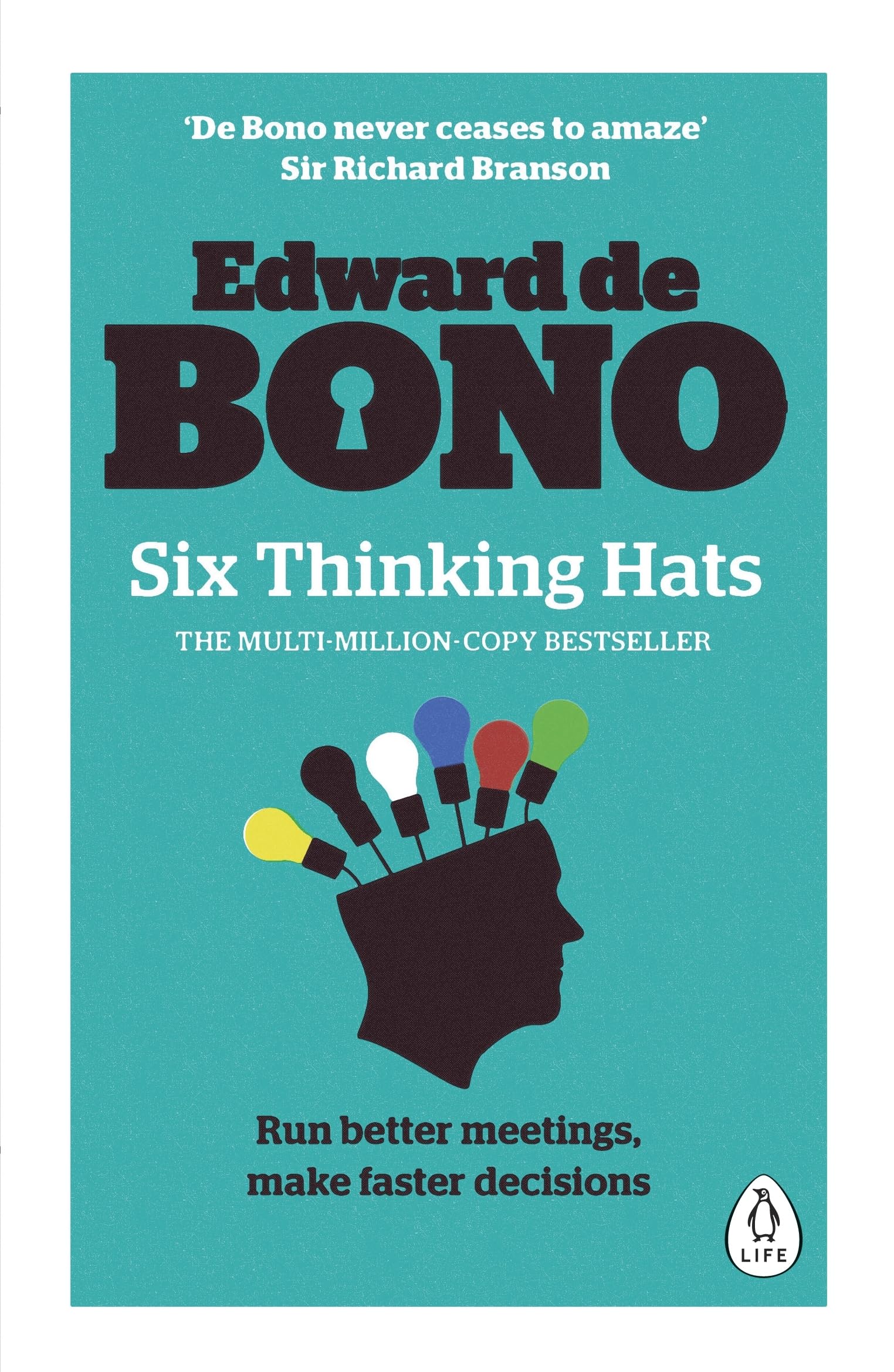
Buy Six Thinking Hats: The multi-million bestselling guide to running better meetings and making faster decisions by de Bono, Edward (ISBN: 9780241257531) from desertcart's Book Store. Everyday low prices and free delivery on eligible orders. Review: A thought provoking book - A good and interesting read Review: Lateral thinking concepts - Eduard De Bono's philosophy is an interesting side step from the functional normality of ordinary thinking, and a valuable teaching aid in helping individuals to think beyond themselves.


| Best Sellers Rank | 27,142 in Books ( See Top 100 in Books ) 218 in Business Development & Entrepreneurship (Books) 268 in Business Careers (Books) 480 in Popular Psychology |
| Customer reviews | 4.4 4.4 out of 5 stars (1,891) |
| Dimensions | 12.7 x 1.27 x 19.56 cm |
| ISBN-10 | 0241257530 |
| ISBN-13 | 978-0241257531 |
| Item weight | 139 g |
| Language | English |
| Print length | 192 pages |
| Publication date | 28 Jan. 2016 |
| Publisher | Penguin Life |
I**Y
A thought provoking book
A good and interesting read
J**S
Lateral thinking concepts
Eduard De Bono's philosophy is an interesting side step from the functional normality of ordinary thinking, and a valuable teaching aid in helping individuals to think beyond themselves.
M**N
A classic "must read"
First published in 1985, Edward de Bono's Six Thinking Hats is a management book whose suggestions are as relevant for successful thinking and decision-making today as they were when the book was first published. De Bono describes a structured method that provides a way to be more impartial as we evaluate ideas, whether doing so as an individual or as a team. The labels he gives to each way of thinking provide a useful code for people to work together effectively in decision scenarios. I recently worked with a couple of organisations where managers were enthusiastic about the "six thinking hats" - and I felt compelled to read the book, so that I was better-versed with the various "hats". Having read the book, I now understand why organisations find this way of encouraging structured thinking to be useful. For me though, having come to this book after using neurolinguistic programming (NLP) for several years, I didn't really learn any new methodology: de Bono's method is strikingly similar to the NLP method of looking at issues from different perspectives; the difference being that de Bono defines and labels the perspectives from which problems should be considered. I would be surprised if the founders of NLP didn't refer to de Bono's work during their search for excellence. This is a short, easy-to-read book which could help you to open up your own or your team's thinking - and give you an easy-to-understand common thinking styles vocabulary. However, if you are already well-versed in NLP, you are likely to already be familiar with much of what this book has to offer.
M**S
if you were to read only one de Bono book, make it this
A lot of people criticise de Bono for what he has done. Well, more for how he has told people what he alleges he has done and alleges the innovations he has made through others. But if he didn't praise himself who would? No-one like to call themselves a bad driver, yet there are a lot out there. Like driving, like golf and one or two other past times, people think they are pretty good at thinking and it cannot be improved. They're not. Yet they can. Simply. OK, this book could easily be shortened, yet books "must be of a certain length to sell", according to publishers. Hence the length. Yes it's long, but who says you must read every word? The summaries do nicely. What works even beter is applying the principles. Use it and see, but do give the exercises an fairs stab at working before deciding.
P**K
Great as a Personal Tool
This is a strange book to review and the reason I say that is because, in theory, it sounds like a great process and methodology, but in reality, it is difficult to manage and can be a disaster. The core reason to employ the “Six Thinking Hats” is in meetings to resolve problems or agree on a way forward while bringing everyone along on a shared vision. It should also make sure that we have been comprehensive in our considerations and approach. The problem is that the Six Thinking Hats, in my experience, has created more polarisation, endless debate, and been unable to perform as a shared methodology. I have been in meetings where a trained “Six Thinking Hats” consultant has been destroyed and the meeting has ended a shambles. Not only because of the actual framework but because of those that can buy into it and those that cannot. The theory and application are such that we put on different coloured hats where each relates to a specific characteristic of thinking. This will enable us to consider any problem comprehensively from multiple perspectives. The six thinking hats are: White Hat: Neutral and Objective – facts and figures Red Hat: Emotional, often anger Black Hat: Sombre and Serious. Point out weakness, negative Yellow Hat: Sunny and Positive. Optimistic and hopeful Green Hat: Creativity Blue Hat: Control and organisation of all the hats Even if we argue that it requires focus, strong management and open-mindedness, the fact that it takes so much effort to get right, is in itself cause for major concern. I would be more inclined to suggest learning this as a leader/manager knowing that they must consider multiple points of view and encourage different perspectives from their team. The notion of role-playing with different hats may work in some environments, but none that I’ve been in.
F**D
This guy is the nuts...
Very helpful in broadening and making the most of you mind. See also this guy's other titles, you won't be disappointed.
C**M
satisfied customer!
all good!
G**S
Essential reading
I need to declare that I am a Six Thinking Hats Certified Trainer. Edward de Bono has in my opinion taken the obvious and added a perspective that adds significant value. The obvious being our ability as humans to think. What we have not been particularly good at is recognising that thinking can be effective or ineffective. The six thinking hats introduces our minds to a new of way of organising our thinking so as to improve the output. In the years that I have taught the skill, I have witnessed vast improvements in the way people make decisions. Additionally the system that Edward proposes benefits meetings by preventing individuals to wonder off and lose sight of the focus. In essence Edward proposes that thinking is divided into 6 categories representing the focus for thinking, information, constructive, cautionary and creative thinking as well as considering emotions. All this artfully connected to coloured hats to add connectively to the type of thinking in progress. A simple yet very effective set of tools that will enhance the quality of your decision making. This book has been such a life changer for me that I included the values in a book I wrote with Edward de Bono writing the foreword. Change Directions: Perceive It - Believe It - Achieve It Georges Philips
A**A
If you want to find a way to make smart decisions without taking too much time, then this book is for you. “Six Thinking Hats” is written by Edward De Bono. He makes a comparison between critical and lateral thinking. As children, we are taught to do critical thinking. We have a problem, we find a solution, and then we spend time arguing why our solution is correct. This method of thinking creates arguments and that is what De Bono tries to eliminate. He came up with the concept of the six thinking hats in order to help people think better. With the six thinking hats, people are able to solve problems without causing arguments. Each hat is represented with different colors and each one has their own meaning. The book is, in a way, divided by the different hats. At the beginning of each section, he explains what the hat represents and he gives examples of how the hat is or can be used. At the end of the “section”, De Bono gives a good summary of the hat. This makes it easy for the reader to clear up misunderstandings that they may have had in the beginning. Also, the concept of the six thinking hats is explained well. Having different colors for each hat is easy to remember what each hat represents and the concept is easy to understand. It may take some time for people to get used to using the six thinking hats but once they get used to the method, their life will become easier. People are able to come up with solutions faster using this method compared to using critical thinking. Using the Six Thinking Hats may also provide better solutions to problems because they will go over different alternatives and the best one will be the final solution to be chosen. This method of thinking allows everyone to participate and they all see each others perspectives on an issue so it is easier to decrease arguments. De Bono explains that there are two purposes for the Six Thinking Hats. The first purpose is to simplify thinking. Focusing on one part of the problem at a time becomes less overwhelming for people. The second purpose is to allow a switch in thinking. Every person has the opportunity to switch their hats so they can see the different sides of their problem. This book can help a business or a group of people improve their communication, increase their creativity, and make better decisions. Overall, this is a book worth buying. The book is easy to read and it is also very educational.
L**H
I'm surprised I haven't come across this work sooner. This book presents an excellent system for breaking things down and ensuring a high quality thinking process. By following this system individuals and teams can more effectively eliminate the risk of decision-making by defaulting to their personality style or tendencies. The six thinking hats process uniquely removes the risk embarrassing anyone or belittling one tendency in favour of another. It, instead, embraces the priority of tapping into all aspects of thinking - one aspect at a time. This is a valuable system that I plan on incorporating into my businesses. In fact, I made contact with the President of the Company, The de Bono Group, LLC, and am thinking about becoming certified as a Six Thinking Hats trainer.
R**U
One of the best books for problem analysis
G**8
Simple and inspiring book
M**A
La metodología de Edward de Bono es de fácil comprensión y aplicación. La técnica es muy visual y de sentido común. El libro puede leerse en muy poco tiempo y, aunque hay que practicar de forma habitual para lograr sacarle el máximo provecho, pueden obtenerse resultados desde el primer día.
Trustpilot
4 days ago
5 days ago


